
How Teamwork Skills Built in School Predict Startup Success (2026)
Most startups don't fail because of bad ideas — they fail because of broken teams, and that pattern often starts in school group projects. Edufy Labs unpacks why early teamwork habits are a surprisingly strong signal for future founders and how leadership skills tie into real, project-based learning.
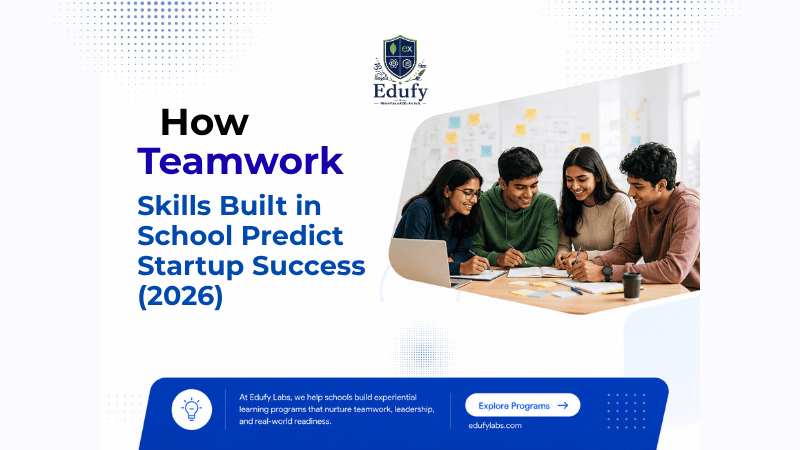
Ask any early-stage founder what actually broke their startup, and marks or technical brilliance rarely come up. What comes up instead is people co-founders who couldn't align, teams that fell apart under pressure, or a founder who never learned to delegate. It's a pattern we've seen repeatedly while mentoring young builders at Edufy Labs, and it usually traces back further than the startup itself, often to how a person handled group projects back in school.
This isn't a nostalgic "school prepares you for life" argument. It's a fairly specific claim: the way a teenager behaves in a school group project, how they handle disagreement, share credit, and follow through on their part tends to resurface almost identically when that same person is running a team years later. In our experience working with teen and college-age learners through our leadership program for teens in Kolkata, this pattern shows up often enough that we now treat early teamwork behaviour as a genuine signal worth paying attention to.
Why Teamwork in School Isn't "Just a Project"
Students see their team-based projects simply as another assignment that must be completed in order to earn a grade. However, a team-based project is actually an abridged model of real-life startups where there are ambiguous roles, unequal distribution of effort, conflict of opinions, and an uncontrolled deadline. The importance of teamwork has been highlighted several times already by global organizations such as the World Economic Forum as one of the key skills that are essential for the future working generation, along with technical competency.
The Skills That Actually Transfer
Teamwork skills for students who show up later in startup life tend to be narrower than people expect. It's rarely about being liked. It's about three specific behaviours:
1. Conflict without collapse. Teens who learn to disagree on a group project without the group falling apart carry that into co-founder disputes, which are near-universal in early startups.
2. Reliable follow-through. The student who consistently delivers their part of a school project, not brilliantly, just reliably, tends to become the founder investors describe as "someone who ships."
3. Distributed ownership. Group projects where one student does everything and others coast produce a very different outcome than those where roles are genuinely split. The latter mirrors healthy startup team dynamics far more closely.
Where Leadership Training Fits
Teen entrepreneurship and leadership training for teenagers isn't about pushing 15-year-olds to launch companies. In our experience, the more useful goal is exposing teens to real team-based problem-solving early, the kind where outcomes depend on more than one person's effort. When we've run structured team-building sessions alongside our technical programs, students who'd had prior exposure to team accountability picked up collaborative coding practices like code reviews and shared task boards noticeably faster than those working solo for the first time.
Where This Connects to Real Skill-Building
Teamwork is the mindset; technical ability is what makes a team's output real. This is where our Full Stack Course with Placement comes in. Students don't just learn MERN stack concepts alone; they work in small teams to plan, build, and deploy actual applications, which is closer to a real startup sprint than a solo tutorial. Our flagship MERN Stack Mastery track pairs MongoDB, Express.js, React, Node.js, and Next.js over roughly 14 weeks with exactly this kind of collaborative, project-based structure, the same team dynamics discussed above, applied to a real product.
A Realistic Note on "Predicting" Startup Success
No single skill "guarantees" a founder will succeed; market timing, funding, and product-market fit matter enormously too. What we can say, based on patterns observed across the students we've mentored, is that early teamwork habits are a meaningful early signal, not a certainty.
Final Thoughts
Startup success is rarely a solo act, no matter how it's portrayed. The habits a teenager builds in a school group project, showing up, sharing credit, and handling friction, often turn out to be the same habits that make or break a founding team years later. That's why we treat leadership and teamwork as seriously as technical skills at Edufy Labs.
Ready to Go Beyond the Syllabus?
Edufy Labs helps students, teens, and working professionals in Kolkata build real, job-ready skills through hands-on, mentor-led programs. Our flagship MERN Stack Mastery track, an AI-aware, beginner-friendly Full Stack Course with Placement support, is designed to take you from fundamentals to building and deploying production-ready applications.
👉 Explore the MERN Stack Mastery Program and see if it's the right next step for you or your child. 👉 Talk to an Edufy Mentor to get your questions answered before you commit.
FAQs
Q: Can school-level teamwork skills really predict startup success?
It may be an indicator but not a promise. Students capable of working with conflicts and being responsible in teams on their school projects will also continue to do so at a startup, but external conditions play an equally important role.
Q: Does Edufy Labs offer a dedicated leadership program for teens in Kolkata?
Edufy develops teens' abilities to lead and work in teams within a framework of collaborative and project-based learning, along with technical skills training such as MERN Stack.
Q: Is teen entrepreneurship something Edufy Labs actively encourages?
The focus of our courses is more on developing skills in working in teams, mastering technologies, and resolving problems that will enable future entrepreneurship.
Q: How does the MERN Stack Mastery program build teamwork skills?
Students work on shared, project-based tasks rather than isolated exercises, which mirrors how real product teams collaborate.

From Idea to Startup: What 90 Days of Building Looks Like
From Idea to Startup: What 90 Days of Building Looks Like
Read story
Meet the Mentors: Real Founders Teaching at Edufy's MERN Stack Mastery Program
Meet the Mentors: Real Founders Teaching at Edufy's MERN Stack Mastery Program
Read story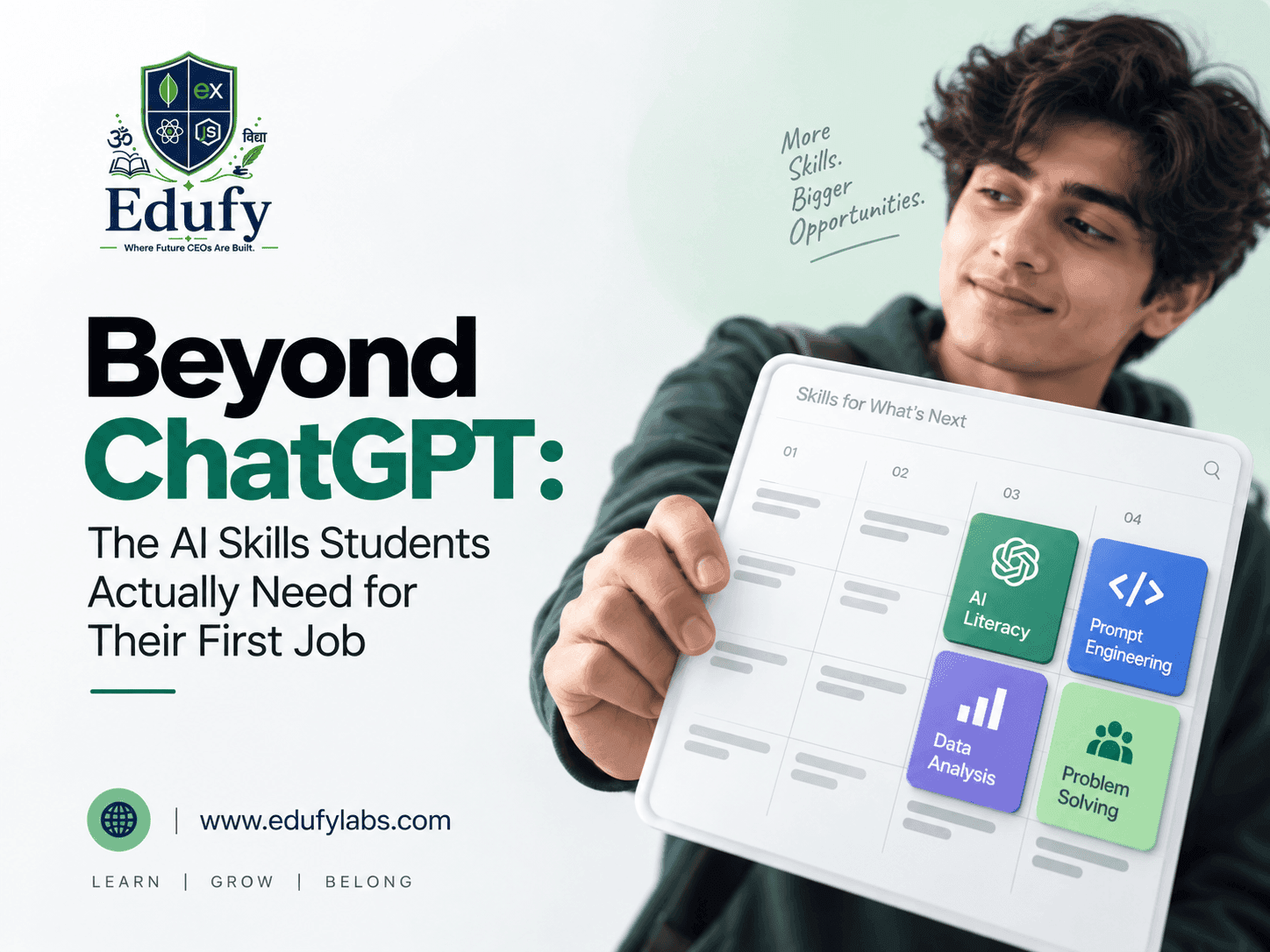
Beyond ChatGPT: The AI Skills Students Actually Need for Their First Job
Knowing how to prompt ChatGPT isn't the differentiator it used to be. This breaks down the actual AI skills recruiters screen for in 2026 —
Read story